
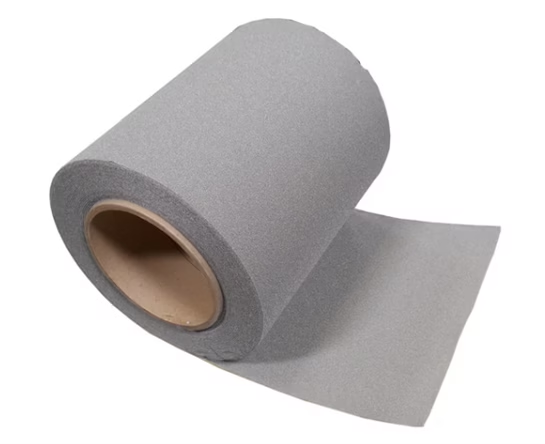
Applications:
Battery current collectors, catalysts, thermal conductive materials, filtration materials, sound-absorbing materials, etc.
Overview:
Nickel foam is a high-tech, deep-processed porous metal in the form of a sponge-like structure made from metallic nickel. It features a three-dimensional, fully interconnected pore network. With a specific gravity of 0.2–0.3, it is about 1/4 the density of water, 1/3 that of wood, 1/10 that of aluminum, and 1/30 that of iron. Its porous structure provides excellent sound absorption across a wide frequency range. It can be cut, bent, and easily adhered, and possesses strong thermal conductivity. The uniform 3D mesh structure allows for effective filtration and highly stable flow of gases and liquids.
The nickel skeleton is hollow and interconnected in a metallurgical state, with porosity reaching 96–98% and a bulk density only 1/50 that of solid nickel. It has a very high specific surface area while maintaining the excellent physical and chemical properties of nickel. These unique structural and performance advantages make it a functional new material with broad application potential.
Application Fields:
Chemical Power Sources:
Used in nickel-metal hydride (NiMH), nickel-cadmium (NiCd), and fuel cells. Nickel foam used as positive and negative electrodes significantly improves battery performance. Nickel foam-carbon composite electrodes are ideal for lithium-ion batteries. Such rechargeable batteries are widely used in mobile phones, computers, electric scooters, e-bikes, hybrid vehicles, electric toy cars, cordless power tools, and consumer electronics.
Chemical Engineering:
Serves as a catalyst and catalyst carrier, filtration medium, and separator medium (e.g., in oil-water separators, oil-gas separators, automobile exhaust purifiers, air purifiers, electronic cigarettes, and range hoods). Its large surface area helps reduce energy consumption and improve efficiency.
Electrochemical Engineering:
Applied in hydrogen electrolysis, electrocatalysis, and electrochemical metallurgy, significantly enhancing energy efficiency.
Thermal Engineering:
Functions both as a thermal conductive material and as a high-efficiency thermal wick for heat pipes, greatly improving thermal transfer performance.
Functional Materials:
Acts as a sound-absorbing material to dissipate wave energy; also used for noise reduction, vibration damping, electromagnetic shielding, stealth technology, flame retardance, and thermal insulation.
Technical Specification
| Type | Nickel Foam |
|---|---|
| Purity | ≥99.8% |
| Form | Sheet or Roll, depending on size & thickness |
| Cell Size (PPI) | 5-150PPI, as per request |
| Thickness | Standard: 1-30mm Extra thin (30mm) can be customized as request |
| Size & Shape | can be made in different shape as per request |
| Porosity | 95%-98% |
| Open Cell Rate | ≥98% |
| Volume Density | 0.1-0.8g/cm3, as per request |
| Thickness | 0.5-10mm available |
| Areal density | 350±20g/m2 |