Model:
Material Name:
Application:
Standard Package:
Overview:
Main Parameters:
| Test Item | Unit | Specification | Typical Value | Testing Method |
|---|---|---|---|---|
| D10 (um) | um | ≥5 | 6.55 | MasterSizer 2000 |
| D50 (um) | um | 12-18 | 14.63 | |
| D90 (um) | um | ≤35 | 28.85 | |
| Tap Density | g/am3 | 1.0-1.2 | 1.10 | Tap Density Tester |
| Specific Surface Area | m2/g | 1.0-3.0 | 1.65 | BET Method |
| Moisture Content | % | ≤0.20 | 0.07 | Gravimetric Method |
| Ash Content | % | ≤0.10 | 0.02 | Gravimetric Method |
| Fe Content | ppm | ≤50 | 10.1 | Atomic Absorption Spectroscopy |
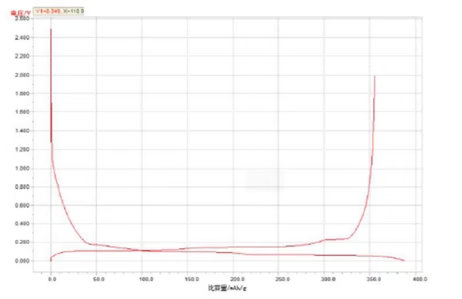
| Specific Capacity | mAh/g | ≥355 | 358.4 | Simulated Cell Test |
| Initial Coulombic Efficiency | % | ≥92.0 | 93.2 | Simulated Cell Test |

Electrochemical Testing:
Test Conditions:
Binder system: SBR/CMC
Composition ratio (MAG-106 : SP : SBR : CMC) = 91 : 5 : 2.4 : 1.6
Electrolyte components: LiPF6 / EC : EMC
Discharge: 0.1C down to 0.001 V
Charge: 0.1C up to 2.0 V, cutoff current 0.01C
Recommended Usage Guidelines:
Design Capacity:
The anode design capacity is 350 mAh/g.
For consumer lithium-ion batteries, an excess ratio of 6–8% is recommended;
for power-type lithium-ion batteries, an excess ratio of 10–15% is suggested.
Tap Density:
The electrode tap density (first roll) is 1.55 g/cm³.
Actual tap density should be controlled between 1.50–1.65 g/cm³, depending on battery structure and performance requirements.
Cycle Performance:
For cylindrical or prismatic aluminum-case consumer lithium-ion batteries:
≥ 80% capacity retention after 800 cycles at 1C charge/discharge rate.
For pouch-type power batteries:
≥ 80% capacity retention after 500 cycles at 1C charge/discharge rate.