
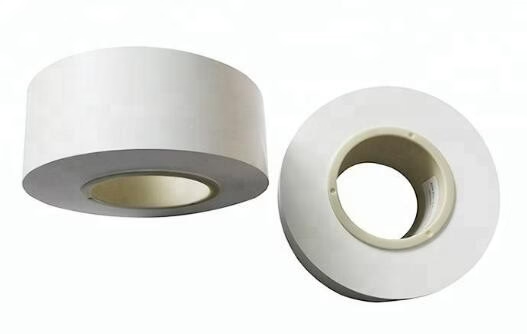
Model: Battery Separator
Material:
Thickness:
Product description:
In the structure of the lithium battery, separator is one of the key component. The properties of the separator determines of interface structure, resistance of battery,directly influencing the capacitance, circulation,safety and other properties. High performance separator is very important to improve the comprehensive performance of the lithium battery.
The main function of the separator is to separate the positive and negative pole, in case of the short-circuiting due to the contact of the two poles. Furthermore, it also help the electrolyte pass through. The material of the separator is non-conductive. Its physical and chemical properties have a great impact on battery performance.The separator will be different according to types of batteries. For Lithium battery series, the electrolyte is an organic solvent system,which is requires a solvent resistance separator material,generally using high strength porous polyolefin film.
Specifications
| Material | Polypropylene (PP) | |||||||||||||||||||
|---|---|---|---|---|---|---|---|---|---|---|---|---|---|---|---|---|---|---|---|---|
| Production Method | Dry Process – Uniaxial Stretching | |||||||||||||||||||
| Technical Parameter | Unit | Specification & Model | ||||||||||||||||||
| Thickness | um | 16um | 20um | 25um | 30um | |||||||||||||||
| Areal Density | mg/cm² | 1.10+0.15 | 1.20+0.15 | 1.25+0.15 | 1.35+0.15 | |||||||||||||||
| Air Permeability | Sec/100ml | 250±100 | 300±100 | 350±100 | 350±100 | |||||||||||||||
| Length | m | +1-10m | +1-10m | +1-10m | +1-10m | |||||||||||||||
| Porosity | % | 43±3 | 43±3 | 43±3 | 43±3 | |||||||||||||||
| Puncture Strength | g | ≥230 | ≥250 | ≥300 | ≥320 | |||||||||||||||
| Tensile Strength (MD) | kafle m² | ≥1200 | ≥1200 | ≥1200 | ≥1200 | |||||||||||||||
| Tensile Strength (TD) | kgflc m² | ≥120 | ≥120 | ≥120 | ≥120 | |||||||||||||||
| Heat Shrinkage (MD) | % | ≤3% | ≤3% | ≤3% | ≤3% | |||||||||||||||
| Heat Shrinkage (TD) | % | 0% | 0% | 0% | 0% | |||||||||||||||
| Performance Advantages | 1. Small and uniformly distributed micropores 2. Excellent microporous connectivity 3. Capable of producing various thicknesses and structural types 4. High tensile strength in the machine direction (MD) 5. Low tensile strength and zero shrinkage in the transverse direction (TD) | |||||||||||||||||||